
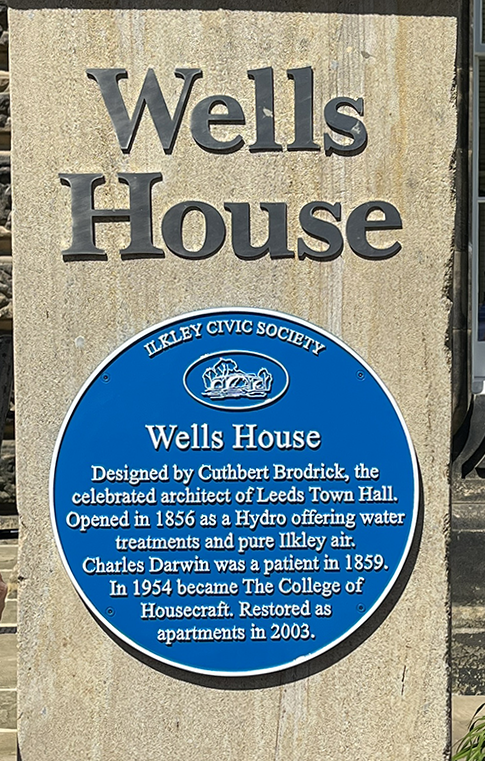
Blue plaque at Wells House
On Saturday 30th May a Blue Plaque was unveiled at Wells House, sponsored by the management committee of Wells House and Ilkley Civic Society. The Ilkley Civic Society’s Blue Plaque Scheme, celebrates the history of Ilkley and of buildings that have shaped the town.
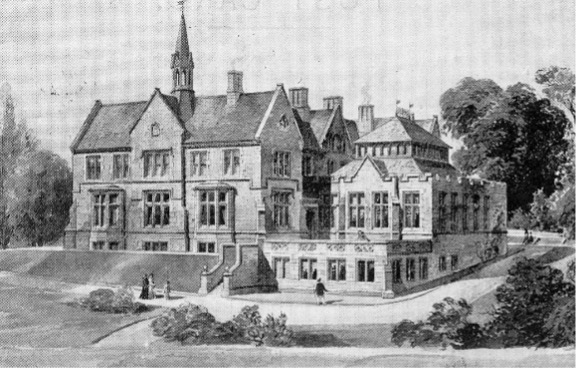
It is 170 years since the opening of Wells House, on 28th May 1856. A group of Bradford businessmen chaired by Benjamin Briggs Popplewell formed the Wells House Hydropathic Establishment and Hotel Company to build the hydro. In 1853 they agreed to buy 9 acres of land on Wells Road, opposite the old Ilkley Wells (White Wells) for £4,000 from the lord of the manor, Peter Middelton. They advertised for designs and chose the Italianate palazzo style by Cuthbert Brodrick, who had recently started work on Leeds Town Hall. The contractors were Pickard and Ogden of Bradford.
By the time the building and furnishings were completed, it was said to have cost in all £30,000. It featured a central open courtyard and an internal corridor, which could be used for exercise in inclement weather. The main large entrance faced south. The spacious dining room with an adjoining drawing room was able to accommodate about 150 guests at the opening meal. Upstairs there were 87 bedrooms with six large bathrooms for treatments. At the four corners there were towers, with the billiard room and the smoking room located at the top of two of them.
Henry Strachan was the well-respected manager, and the first doctor was Dr Rischanek of Vienna. Both had worked at the Ben Rhydding Hydro. The second doctor was Dr Edmund Smith, who treated Charles Darwin in 1859. When Dr Smith died in 1864 his grateful patients installed a stained-glass window of St Luke in All Saints Parish Church.
The next Civic Society walk is on Saturday June 20 at 2pm from the Canker Well. For more information contact