Ilkley Hydros and Ilkley Cemetery - Walk August 2026
This walk, researched and written by Denise Shillitoe, explores the people buried or commemorated in the cemetery whose lives were connected with Ilkley’s hydros. Some were owners, some were patients, others were visitors, and some were workers.
As we move through the cemetery, we give a very brief history of Ilkley’s hydropathic establishments and introduce some of the people linked to them. The location of the graves is indicated on the map below and the numbers correspond to the descriptions in the text.
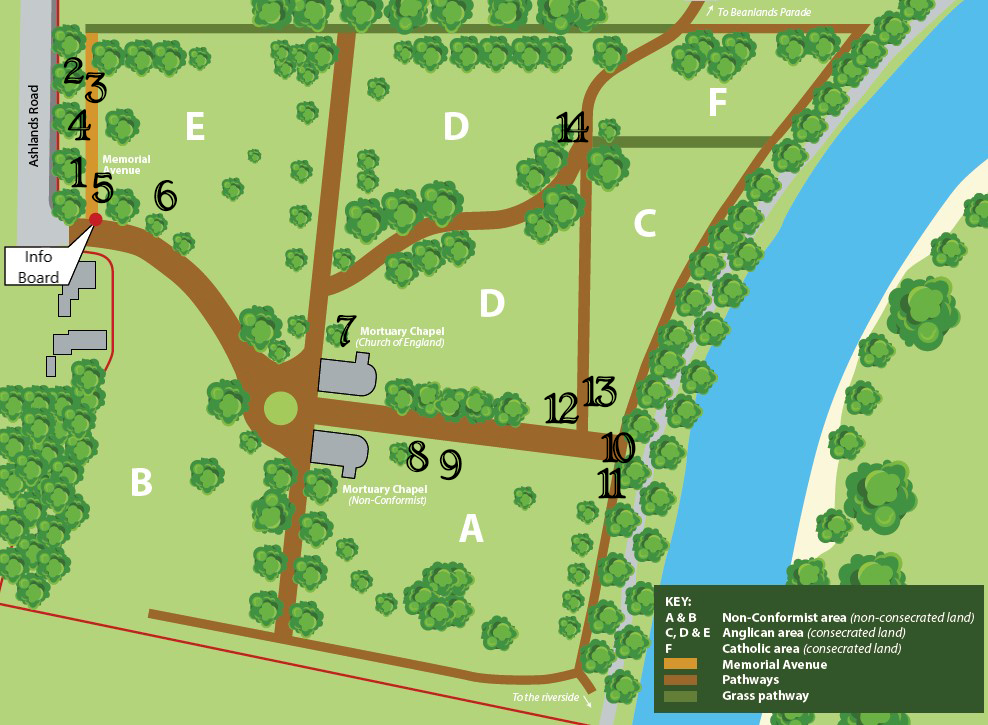 Cemetery map showing position of graves
Ben Rhydding was the first hydro. It was built on 65 acres of land at Wheatley. It opened in 1844. Others soon followed: Wells House in 1856, Craiglands in 1859, Troutbeck in1863, The Grove/Spa in 1864, Rockwood in 1868, Marlborough House in 1880 and finally Stoney Lea in 1883.
That’s a lot of hydros for one small town. It shows the immense popularity of the water treatment in Victorian times. Their story can be enhanced from a study of the graves here in the cemetery.
Start at the cemetery gates at the end of Ashlands Road.
Memorial Avenue
Our journey starts here. We are standing at one end of what’s called the memorial avenue. Although there are rows of grave-stones on each side, there are no actual burials in the avenue. All the stones are from burials in the churchyard of All Saints, the parish church.
On the corner of Church Street and New Brook Street in the centre of Ilkley there are now flower beds and some benches. There used to be a hotel there, called the Wheatsheaf. It was demolished in the 1960s and the Council decided to tidy up the area. This included part of the churchyard. A lot of the stones were removed although none of the burials were disturbed. They were brought here for storage and stacked up on wooden pallets which, of course, began to decay and become unstable. By 2004 the stones were in a poor condition so with help from Bradford Council, Ilkley Town Council and private sponsors, Ilkley Civic Society were able to start laying them out into a long avenue. The process was completed in 2011.
Move down the avenue to look at the first stone
(1) The grave of William & Elizabeth Butterfield [Gravestone 65b]
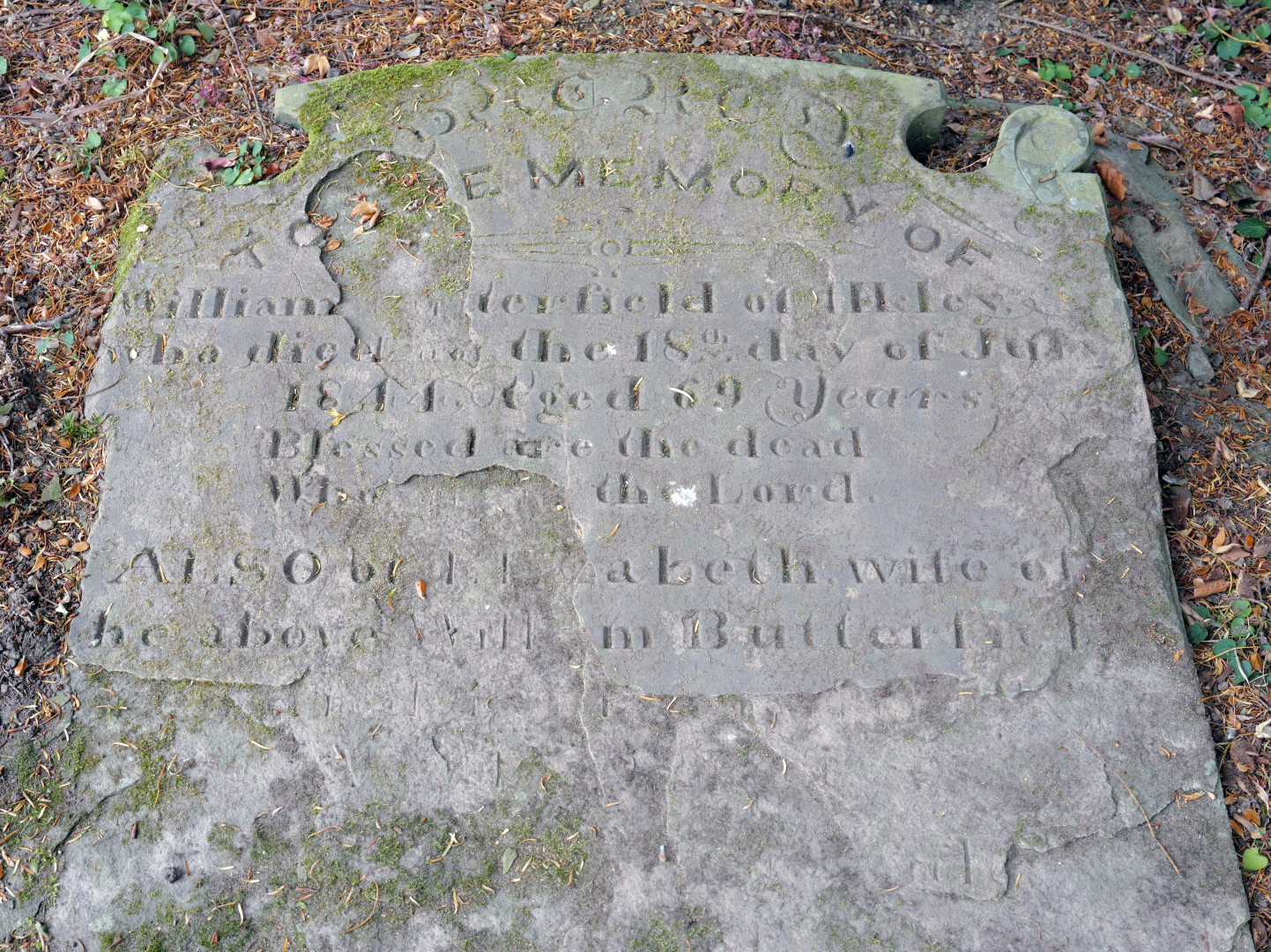
William was born 1775. He was a husbandman/woolcomber when he married Elizabeth Hodgson in 1800. From 1820 to his death in 1844 he was the bath man at White Wells.
White Wells is the place on the edge of the Moor where the water cure started in Ilkley. It’s still there. Many of you may have visited the café. Perhaps some of you have taken part in the New Years Day dips in the bath.
It opened as early as the late 17th century and was enlarged in 1791. There were two plunge baths and the water was always at a steady temperature of 45 degrees Fahrenheit. There was also a drinking fountain noted for the purity of the water. There were no minerals to give it an unpleasant taste.
This purity was true of all the other Ilkley wells except for the one known as the Canker well, which contained iron. Cankers are sores in the mouth and are still thought to be linked to iron deficiency. The Canker well is dry now. It’s at the end of the Grove. It’s been in the news recently because it’s just been refurbished by the Ilkley Civic Society to celebrate its 60th anniversary.
William’s job as a bath man was to help the bathers, look after them and the building. He also ran a donkey transport business which carried patients up the steep hill from town. His wife, Mrs Butterfield regularly led the donkeys as she also helped as a bath woman assisting the female patients.
His son William followed in father’s footsteps and he had another son, John, who we will discover later.
(2) The memorial stone to Edward Usher, his wife Grace & their daughter Elizabeth. [Gravestone 49]
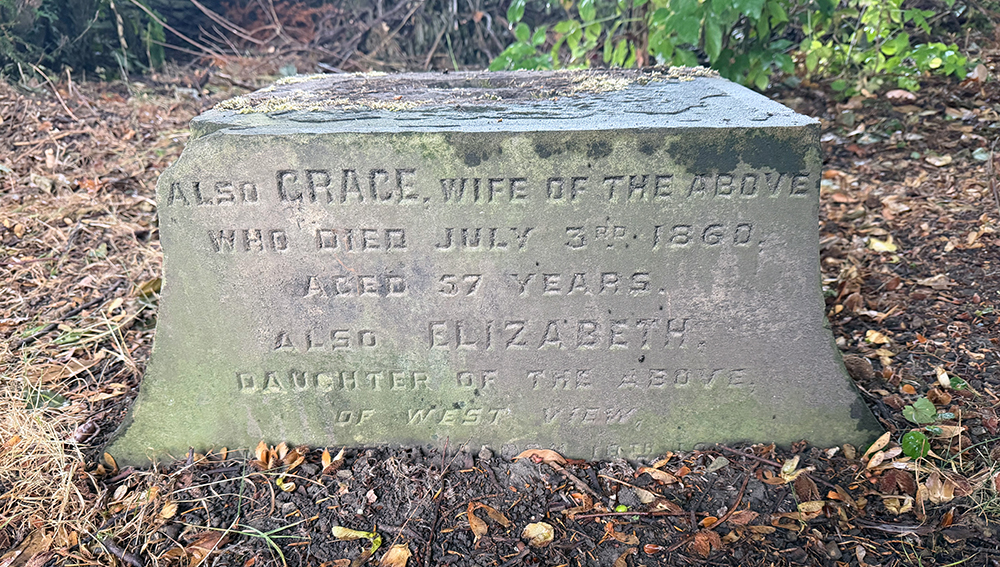 Edward was born 1801. He started life as a builder but from 1840 he and Grace ran a boarding house. One of the boarders was Dr Rischanek. Dr Rischanek was a medical doctor who had come to Ilkley from Silesia on the invitation of an old patient from Ilkley who had been treated by him in Silesia. At first he used White Wells to administer his cold-water treatments. Later he moved to Ben Rhydding Hydro as its first medical superintendent.
The treatment at Ben Rhydding involved a plunge into a cold-water bath or a cold-water shower followed by being tightly wrapped in wet sheets. This was done daily, accompanied by exercise and fresh air.
Edward died in 1852 but Grace and their daughter Elizabeth carried on until Grace’s death in 1860.
Elizabeth took over for a while and later ran a lodging house at no. 3 West View until she died in 1919.
Usher’s Boarding House became Crescent House and then Rombalds before being converted into apartments.
If you look at the stone you can only see the names of Grace & Elizabeth. But we know Edward was also there because Arthur Kitching the well-known local artist and who worked for the Council transcribed all the inscriptions on all the stones before they were removed.
Three more gravestones of patients who died whilst being treated at Ben Rhydding Hydro.
We don’t know what they died of, but in 1849 the physician, Dr Macleod, advertised that he specialised in treating dyspepsia, constipation, skin & liver diseases & what he discretely described as female diseases. So it could have been any of those, or perhaps the shock of being doused in cold water and wrapped in wet towels was enough to tip people over the edge.
One reason for highlighting this next group of graves to you is to make the point that the patients were generally relatively affluent people who often travelled appreciable distances to receive the treatment.
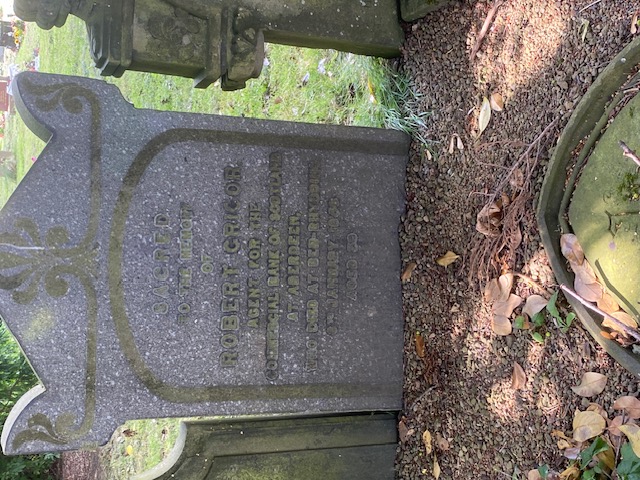 George Grigor
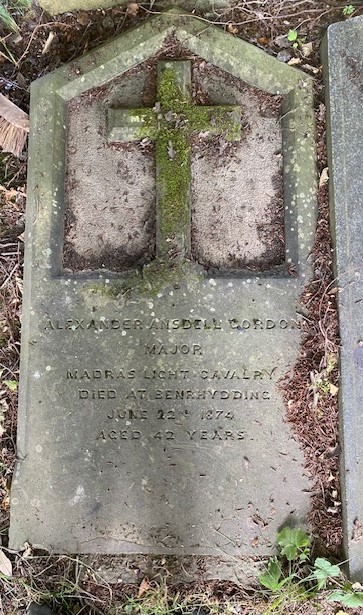 Alexander Gordon
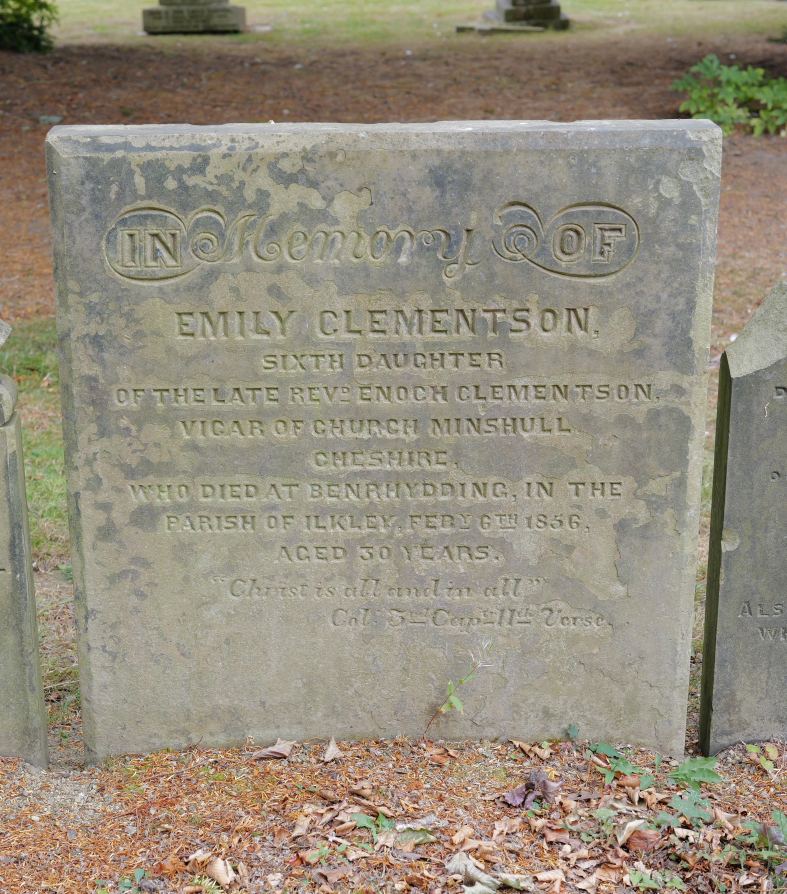 Emily Clementson
(3) George Grigor/Gregor (42a). He was a patient who died at Ben Rhydding Hydro in1856. He was an agent for Commercial Bank of Scotland in Aberdeen.
(4) Alexander Ansdell Gordon (62a) died at Ben Rhydding in 1874. He had been born in Cape Town in 1832. He joined 7th Madras Light Infantry becoming a major by time he retired.
(5) Emily Clementson (2a) died 1856 at Ben Rhydding. She was a daughter of Rev. Enoch Clementson, vicar of Church Minshull, Cheshire.
Head up towards the two chapels; there is an area on the left with no visible signs of being graves, so please tread lightly.
(6) Some unmarked graves
We are not entirely certain why there are no stones here. Most probably they were damaged at some point. There are also a lot of so-called pauper’s graves around here and they were never marked. Fortunately, Bereavement Services in Bradford keep a map of all the burial plots, so we know who is buried where. Bereavement Services will locate a grave for you if you know the name and date of death.
Below us lies the grave of Jeremiah Barker & Sarah Barker and next to it is the grave of John William Butterfield, Sarah’s son from an earlier marriage.
This gets complicated, but the central figure is Sarah. She lived to a grand old age. We don’t know exactly how old she was when she died in 1901 because – putting it politely – her age on census returns is not consistent.
John William Butterfield was Sarah’s son by her first marriage to John Butterfield, and he was a stone mason. During Sarah’s first marriage, to John Butterfield, they lived in Chapel Lane. John is described as a woolcomber and lodging house keeper. Later he became the governor of Ilkley Hydropathic Hospital and Sarah was the matron. He was not a governor in the sense of, say, a school governor, but perhaps superintendent would be a better word nowadays.
The Hydropathic Hospital was demolished years ago but it was on Leeds Road, probably on the corner of Weston Road, and catered for artisans & their families who could not afford the fees at Ben Rhydding Hydro. Dr Macleod, the physician at Ben Rhydding Hydro gave his services free of charge, but patients paid 10s a week for lodgings, food and baths.
John Butterfield died 1853 aged 40. He was buried in All Saints church yard but unfortunately his gravestone didn’t survive the move. A bath man from Ben Rhydding called Michael Dobson then became manager of the hydropathic hospital. He later built Holly Bank House, which is further down Leeds Road where the Community Cutlery shop now is.
Sarah remained at the Hydropathic hospital for another 10 years and then it moved to the west end of Cross Beck Road. There it had facilities for 16 boarders. In 1876 Sarah married Jeremiah Barker. Jeremiah was also a stone mason and in charge of the construction of Marlborough House Hydro. This Hydro was on Clifton Road and opened in 1878.
Sarah became the manager, in control of all the household arrangements. She already had many years’ experience in the hydropathy business from her time at the Hydropathic Hospital.
Marlborough House was specifically built as a hydro. The physician was Dr Thomas Scott who also worked at Craiglands. Marlborough House was famed as being compact & comfortable with an excellent view over valley. Facilities for tennis, croquet, billiards were available, free of charge.
After Sarah died Marlborough House continued to operate becoming more of a hotel and a conference centre. It was used by the Australian Rugby League team as their headquarters when touring England. By the end of its life many of the residents were permanent occupiers. It closed in 1970s and was demolished. Marlborough Square was built on the site.
Walk to the left of the left-hand chapel
(7) This is the grave of Henry Strachan
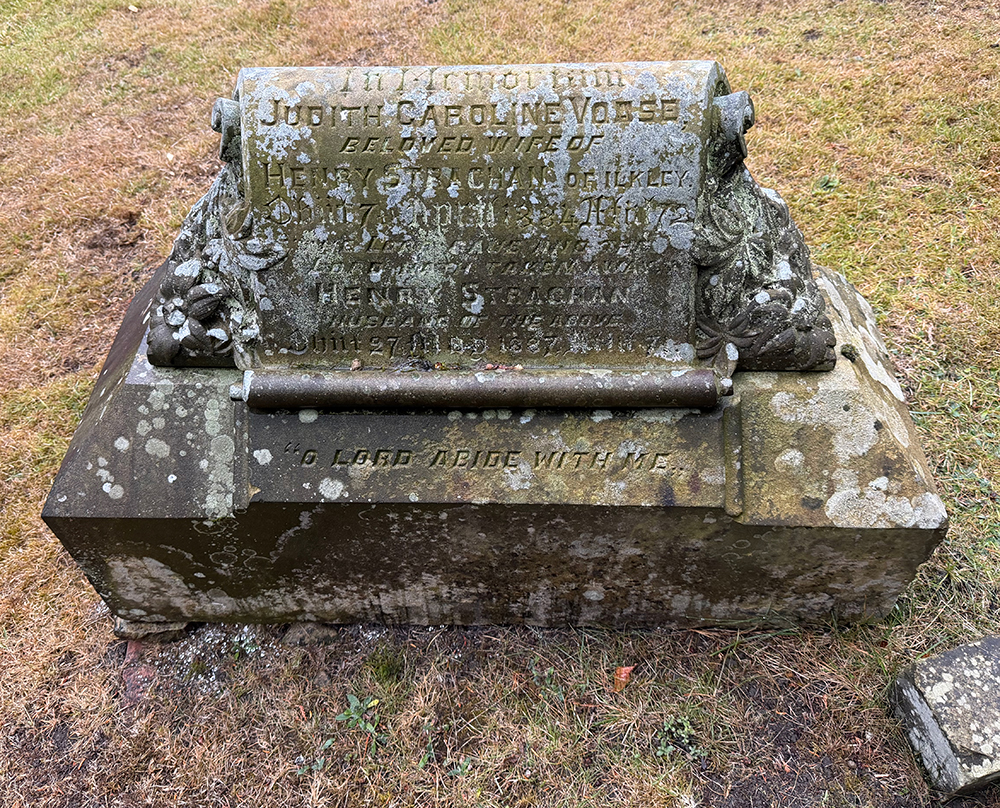 Henry was born in London in 1816 and came to Ilkley to be house steward at Ben Rhydding Hydro when it opened in 1844. Together, he & Mrs Boyes, the housekeeper, ran the establishment. He married a widow, Judith Caroline Voase Hall, in 1848. You can see her name on the grave.
At first Ben Rhydding Hydro wasn’t very successful. Dr Rischanek was the first physician but wasn’t liked by his patients and left due to ‘ill health’. He was replaced by Dr Macleod.
Wells House opened in Ilkley in 1856 and Rischanek, who had been invited back, became physician and Strachan moved from Ben Rhydding to became house steward.
Strachan stayed at Wells House for about 20 years, living with his wife at 3 West View before retiring to No 27 The Grove (this is not the main shopping street as we understand it today, but it is now Grove Road). Judith died in 1884 and Henry in 1887.
Wells House has a long history.
The land was purchased in 1853 for £30,000 and it opened three years later. The architect was Cuthbert Broderick who also designed Leeds Town Hall. It had 87 bedrooms, 6 baths 13 private sitting rooms and the obligatory billiard room. There were nine acres of grounds which included a roller-skating rink on the eastern side. Dr Rischanek stayed 2 years after which Dr. Edmund Smith became physician.
Its most famous visitor was Charles Darwin who was staying there when On the Origin of Species was published.
In the 1880s it was renamed Wells House Hotel. A Winter Garden was built over the rink and an annex built. In the 1930s the band leader Victor Sylvester was a regular attraction at the dinner dances, wedding receptions and social functions.
During the Second World War it was requisitioned by the Wool Control. Following the war, it was purchased by West Riding Education Committee, and it was opened in 1952 as a training college for domestic science teachers – known as the ‘Pud or pudding school’. The annex became student accommodation and the Winter Garden a library.
It then became Bradford & Ilkley College and more buildings were added. It closed in 1999, the modern buildings were demolished and houses were built. The main house and annex were converted into luxury accommodation.
Rejoin the main path between the two chapels. After a few yards on the right is a large and surprisingly low-key plot.
(8) Dobson family grave
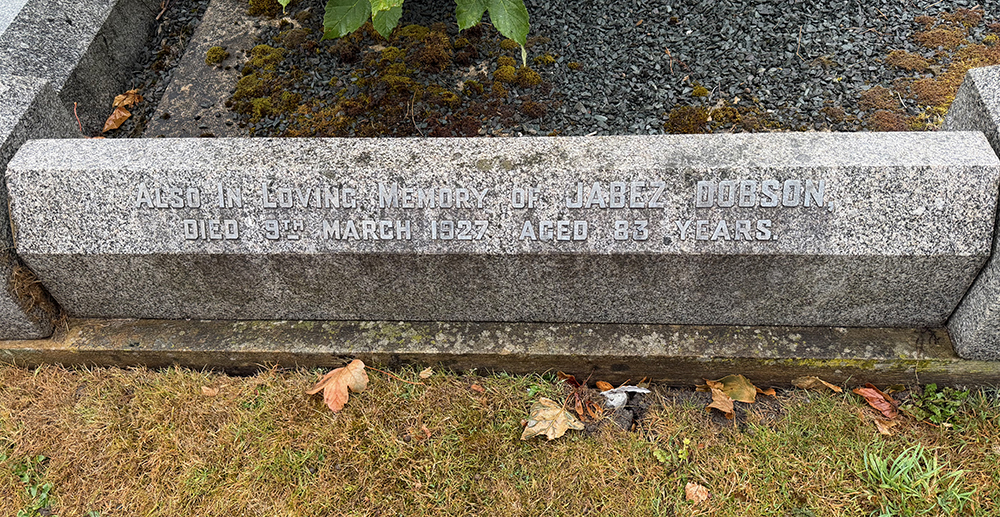
There is no towering monument, no sculpture and no uplifting inscriptions. But it is an important grave in our story. It holds Jabez Dobson, his wife Hannah, his two sons Sidney and Maurice and his daughter in law, Ethel.
Jabez is an important figure in the history of Craiglands. This is large hotel, on Cowpasture Road in Ilkley. It had been built as a hydro by Jabez’s father Michael in 1859. Michael had been a well-known figure in Ilkley hydros for many years. He had started out as a bath man at Ben Rhydding Hydro, then ran Ilkley Hydropathic Hospital and then built Holly Bank House.
In 1870, after his father had died, Jabez took over Craiglands. He began to enlarge the facilities, adding writing & smoking rooms, a castellated dining room, a ballroom with a highly polished dance floor and a stage. He expanded its capacity from 60-70 visitors at a time to over 200.
He was a man of some standing because when he married Hannah Thwaites at Ilkley Parish Church in 1870, he spent £2 12s on flowers including six camelias and nearly as much on bellringing, vicar and guard of honour. They honeymooned in London, spending 10 days visiting theatres, museums, galleries, the Zoo, Crystal Palace and attended several concerts.
He was described as being very clever in business management and it is hardly surprising that he became heavily involved in local affairs. He became a member of Ilkley Local Board in 1876 and later became its chair. He was involved with the purchase of Ilkley Moor and gas works for the board and for the layout of the Tarn.
The cemetery where we are today opened in 1878 and one of Jabez’s responsibilities was its layout. One of the first burials he was responsible for was that of his uncle John. We will visit his grave in a moment.
Jabez left Craiglands in 1911 to live at a large house named Woodbank on Queens Road. That house has been demolished but the modern house on the site is also called Woodbank. Hannah died in 1915 and Jabez in 1927, of pneumonia.
Sidney, who is also buried here, was the eldest son of Jabez and Hannah. He never seemed to have had an occupation. He appears to have enjoyed drinking more than just the local healing waters because in 1911 when he was 37, he was admitted for 12 weeks to what was called “a sanitorium for inebriates” in Beckenham, Kent. It must have been the Priory Clinic of its day.
The treatment was a so-called tonic of quinine, gentian and capsicum with minute doses of strychnine and atropine. He had to drink this six times a day and his freedom of movement was strictly curtailed for the first few weeks. How far he recovered, either from the alcoholism or its treatment we don’t know, but he died in 1921 at Woodbank, where his father Jabez was still living.
The other son, Maurice who also lies in this plot, was educated at Ilkley Grammar School. He trained as a doctor at Leeds Medical School and Guys Hospital in London, where he became a physician. During the First World War he treated soldiers based at Woolwich Garrison.
After the war Maurice returned to Ilkley with his wife Ethel May King who is also buried here and lived at Rombalds House on Crossbeck Road. He became the physician at Craiglands and followed his father’s footsteps into local government. He became the chair of IUDC in the mid-1930s and was awarded the OBE. His wife Ethel died in 1949 and he in 1952.
His daughter Jean and her husband ran Craiglands until 1973. They added the modern glass extension that you can see on the west side of the building. Although it has had many owners since, today it is the only former hydro in Ilkley that still operates as hotel.
(9) The adjacent plot houses Hezekiah Dobson
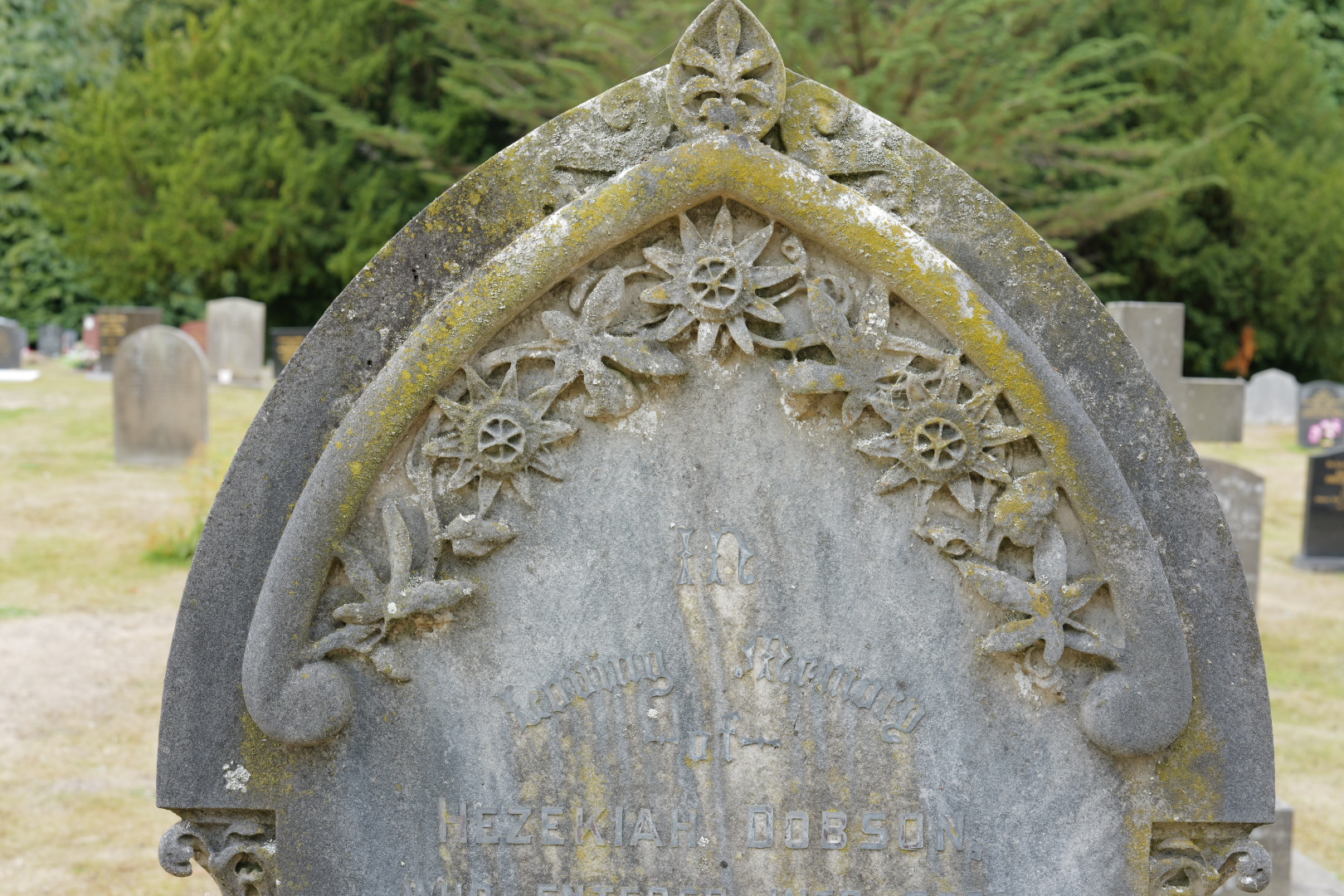
He was the brother of Michael Dobson and never ran a hydro but was heavily involved in the hospitality business. He built The Royal Hotel for £4,000 which opened in 1870. This was at the junction of Wells Road and Wells Promenade, near the location of the upper corn mill. This explains the name of the local stream, Mill Ghyll.
The Royal Hotel was renowned for its food & drink. J B Priestley held a wedding reception there for his sister & husband Paul Scott. During the Second World War it was used by the many officers in the army who were stationed in Ilkley. The hotel was demolished in 1960s and replaced by Wells Court – then regarded as state-of-the-art flats.
Walk to the end of the path
(10) John Dobson (senior)
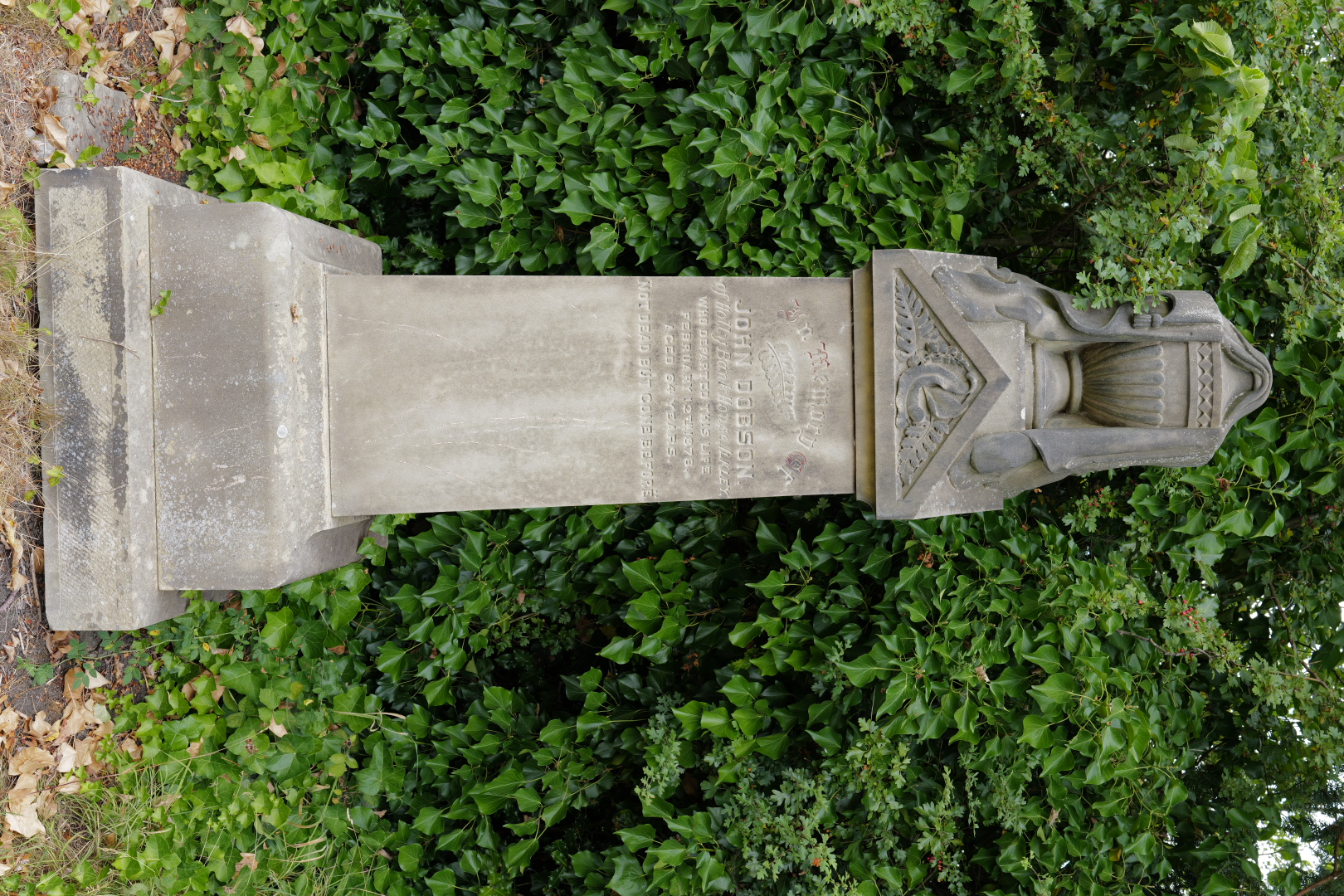 John Dobson monument
The monument to John Dobson, another member of the Dobson family is grander than those of his brothers. John Dobsonwas born in 1813, brother to Michael and Hezekiah Dobson.
After Michael built Craiglands, John moved to Holly Bank House on Leeds Road, where he ran a lodging house with his sister Mary as housekeeper. He never married. He was a bath man at Ben Rhydding and Craiglands, and, like other members of the Dobson family, served on the Local Board. John died in 1878, His obituary recorded his love of nature and his travels in Scotland, Wales and Switzerland.
Move a few feet to the right
Somewhere under the trees here, among the ivy, are the graves of (11) Ann Dobson & Vincent Dobson. They were the wife and son of another John Dobson, brother of Jabez Dobson.
I hope you will have noticed that the Friends of Ilkley Cemetery work hard to keep graves looking reasonably tidy. We have not tackled this bit because we don’t think any visible monuments remain even though we know the graves are here.
Ann and John ran a hydro called Troutbeck from 1875. Troutbeck was situated on Crossbeck Road, just around the corner from Craiglands. It had been built by Bradford architect Samuel Jackson for Dr Edmund Smith of Wells House in 1863. Guests used Craiglands facilities and were attended by the doctor from Craiglands.
But the business became overextended. John was declared bankrupt and his brothers purchased Troutbeck for £8,700. So, it stayed in the family and bad publicity was averted. John left Ilkley, and in fact left England altogether. He became a purser on a passenger liner. When younger he had worked as a waiter at Craiglands, In 1890, while on a voyage to New York and South America he disappeared overboard and was drowned. He was 42.
The family suffered further tragedy the following year. In January 1891, John and Ann’s ten-year-old son, Vincent Troutbeck Dobson, stood too close to an open fire. His clothes ignited and he was burned to death. Two months later, in March, Ann his mother died. Somehow, it seems appropriate to let Ann and Vincent rest in peace hidden together here under the trees.
Troutbeck continued to trade as a hotel. Prince Charles once stayed there. It became well known for hosting pop and rock concerts in the 60s. The most famous musician to play there was probably Jimmy Hendrix. It closed as a hotel in 1985 and became a nursing home for a spell. It has recently been refurbished and will soon be opening as a nursing home under the name of Verbeia Grange. Ilkley Civic Society will be unveiling another of its Blue Plaques there.
On the opposite corner to the John Dobson monument you will find a red headstone
(12) Alexander Williams, 1842-1911
Alexander had nothing to do with the building or management of any of the hydros nor was he a native of Ilkley. He was simply a guest who died during his stay at Ben Rhydding hydro and was buried here.
He was born 1842. He worked initially as a clerk for a Spanish Company called the Wisdom & Warter Sherry House. What a fantastic name for a sherry company! He moved to Spain with his wife and opened a bodega or wine shop, in Jerez, Spain, the centre of the sherry trade. He became well known to English residents in Southern Spain and Gibraltar for his hospitality.
In 1911 he came to Ben Rhydding with his family on holiday. Unfortunately, he had a stroke and died, aged 69.
Continue round the corner to your right.
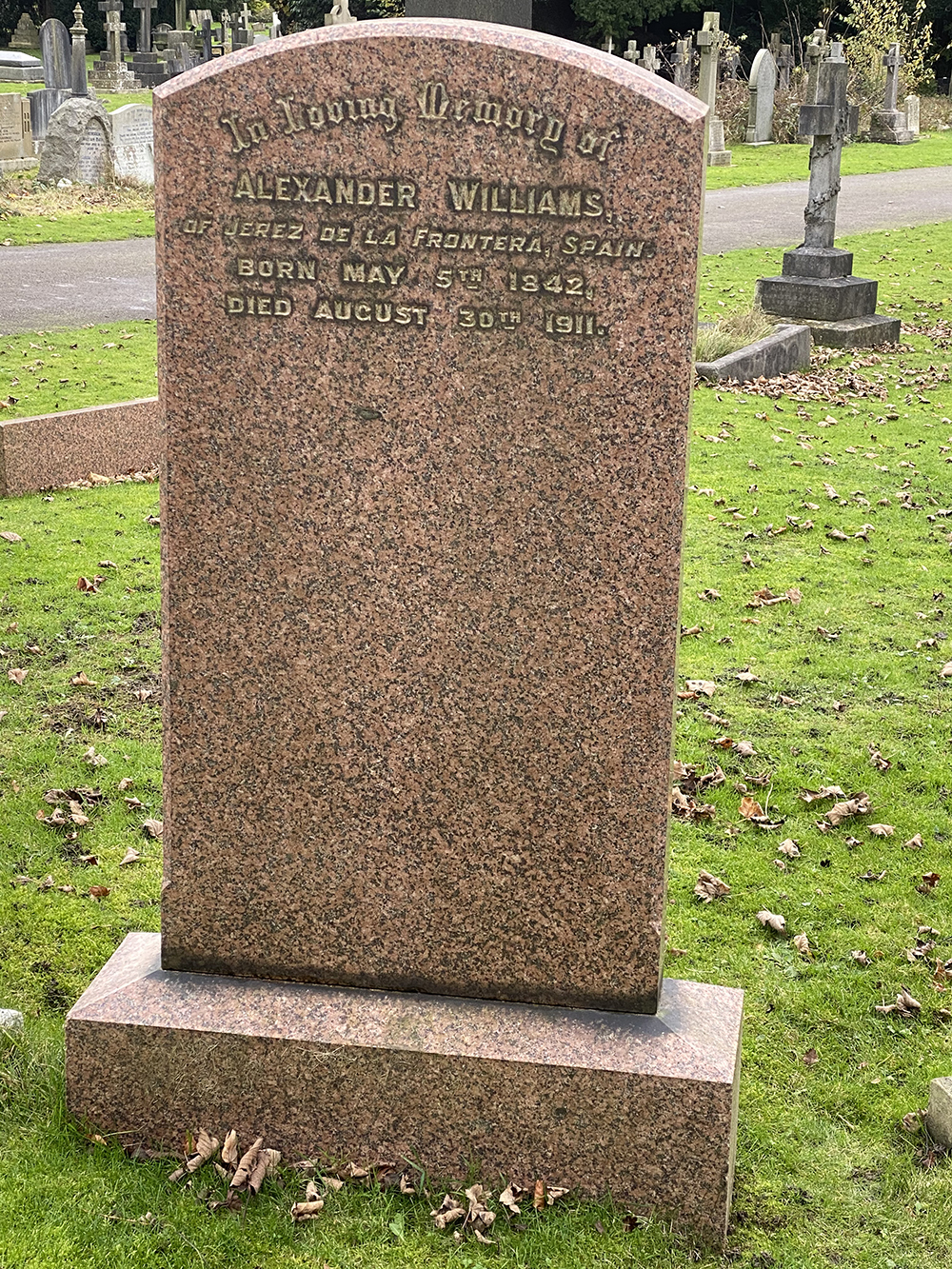 Alexander Williams
 Thomas Emmott
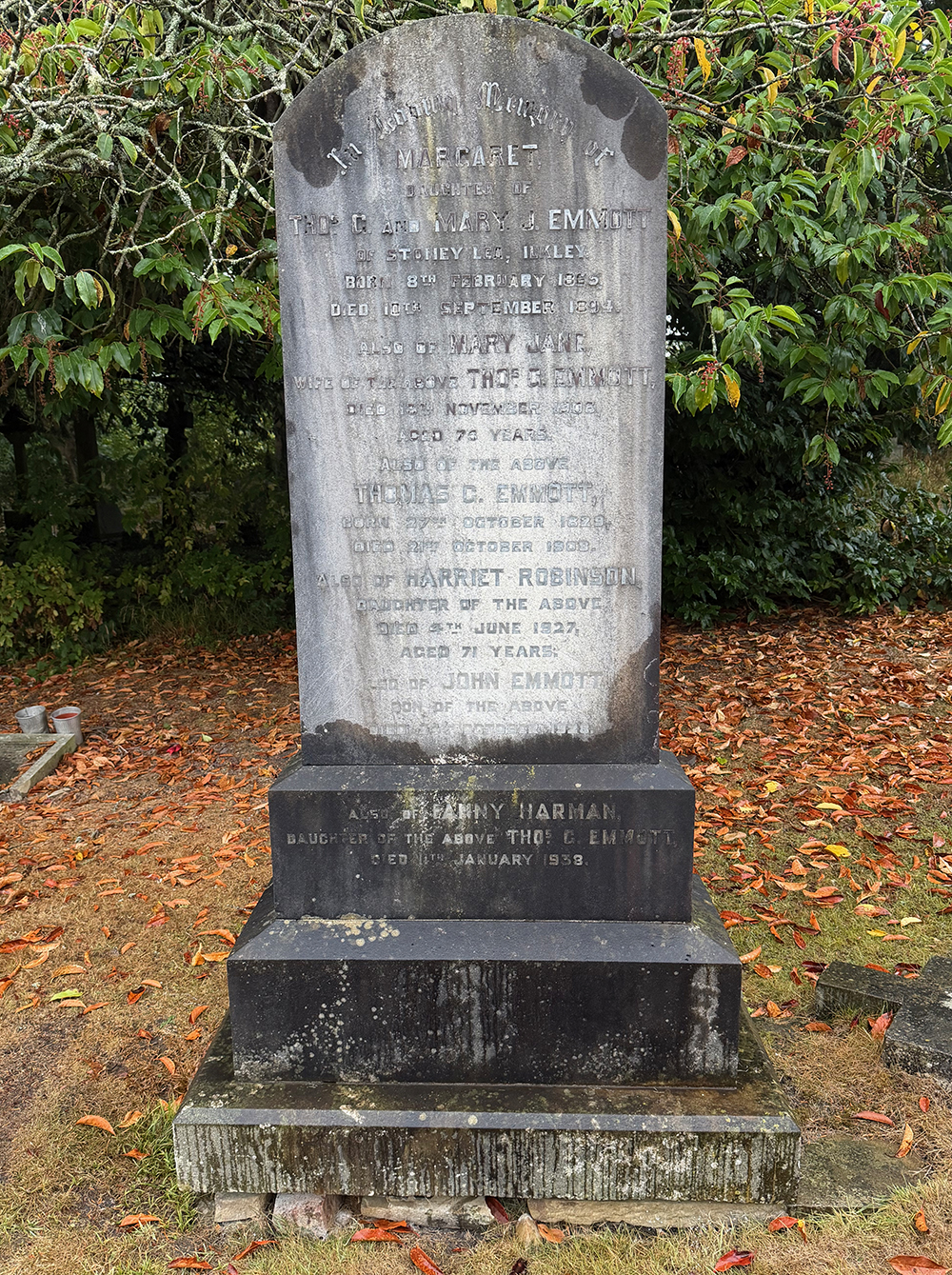
(13) Grave of Thomas Emmott
The next hydro to talk about is Stoney Lea, which was built as a hydro in 1883. It was a grand establishment. It had a full range of baths, a recreational hall and winter gardens. There were drawing, dining and billiard rooms. There were Croquet & tennis courts in the grounds. It became well known for the high quality of its food.
The key figure in the early history of the hydro was Thomas George Emmott. Thomas was someone who did very well for himself from unpromising beginnings. His parents lived in a thatched cottage in Brook Street. When his mother was pregnant with Thomas, his father, who was a labourer, fell from the roof and died from his injuries. That was in 1829. Thomas also started working life as a labourer, but by the time of the1861 census he was a bath man at Ben Rhydding Hydro, and he was living with his wife and children nearby at Wheatley Hall.
A lot of the land in and around Ilkley had been owned for generations by the Middelton family but they fell on hard times and began selling it off in a series of land sales. Somehow, Thomas raised the capital to buy a plot and he built the houses at 5 & 6 Wells Walk. He and his family lived at 6 Wells Walk which they christened Oakley House. He continued to be a bath man at the hydro, although he also described himself as a lodging-house keeper.
In 1882 he advertised for tenders to build a large house on Cowpasture Road at the junction with Wheatley Road and Ben Rhydding Road. It was built quickly and in 1883 it opened as the Stoney Lea Hydropathic Establishment. Thomas was both proprietor and manager. I am not sure where his money came from but either he was getting very good tips as a bath man or his wife had inherited some money. (her father was a land surveyor), but Thomas now owned not only the houses in Wells Walk but also Stoney Lea. Over the years Thomas made many additions to the hydro including a winter garden and a billiard room.
His wife died in 1906 and Thomas in 1908. Two of his daughters (also buried here), Fanny Harman Emmott and Harriet Robinson, continued to run Stoney Lea until their deaths – Harriett in 1927 and Fanny in 1938.
By then hydropathic establishments were well into their long decline. It was no longer fashionable to be wrapped in cold wet sheets. Finally, in the 1930s, Stoney Lea bowed to the inevitable. It became a licenced residential hotel, specialising in coach parties. In the late 1940s the New Zealand and Australian Rugby League touring teams used Stoney Lea as their headquarters. During the 1950s, 60s, & 70s it became a popular venue for dances and discos.
It was demolished in 1981 and in 1986 it was replaced with residential properties: Tarn Court, Tarn Mews and Moorside Court.
Continue along this path beyond the junction with the next path.
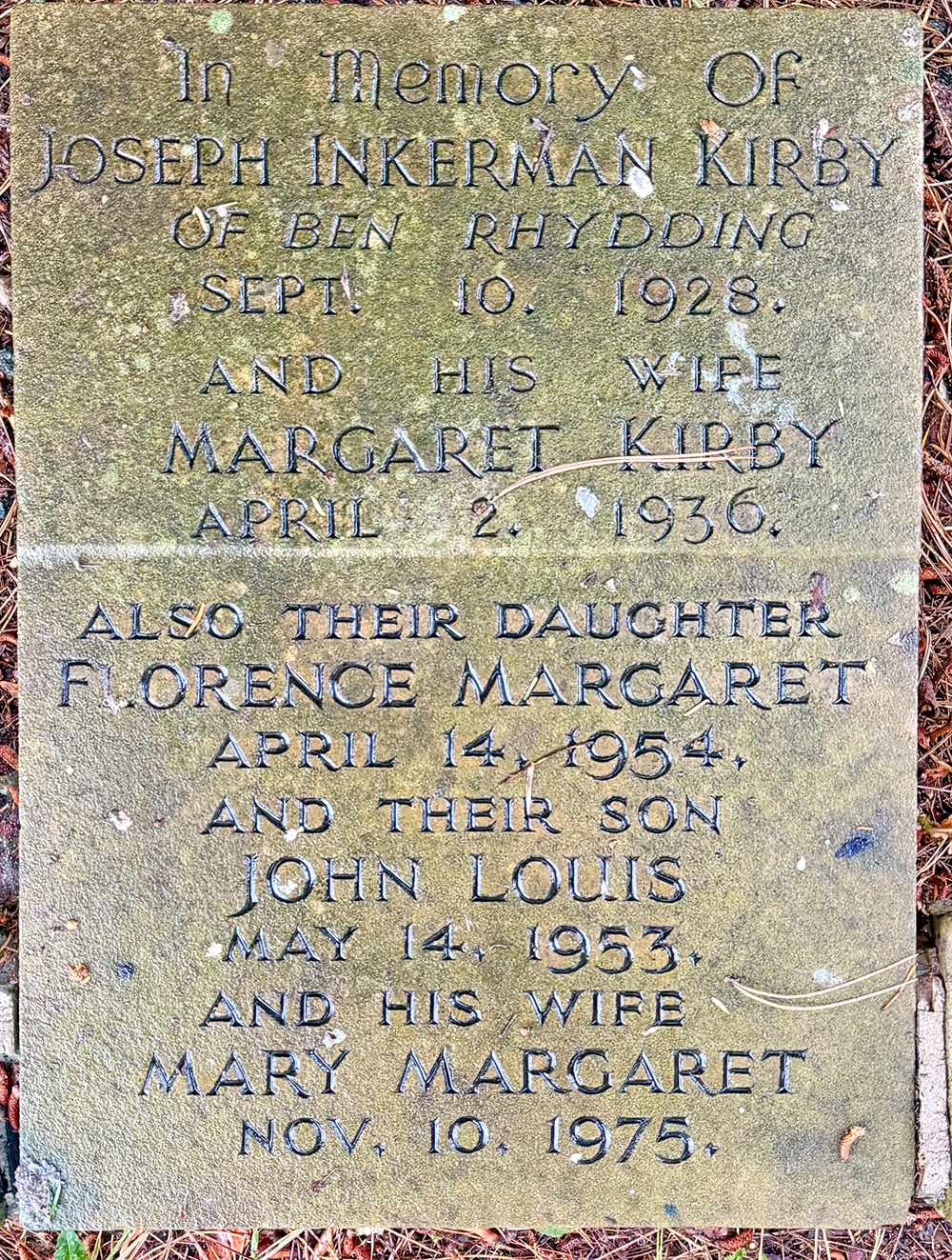
(14) The grave of Joseph Inkerman Kirby (1855-1928)
 This is our last stop, finishing at Ben Rhydding Hydro.
The Victorians often named their streets after naval battles. In Ilkley we have Trafalgar Road and Nile Road but Joseph’s parents seem to have named their son after a land battle in the Crimean War. The Battle of Inkerman had been fought a few months before he was born. He was another figure who combined business management with an involvement in local affairs and civic duties.
He was elected to Ilkley Local Board in 1882 and in 1887 was heavily involved with Ilkley Jubilee Celebrations for Queen Victoria. He was also Secretary of Ilkley Constitutional Club. His father was a coal merchant near Thirsk. Joseph became a timber merchant in Bradford but in 1890 he became the company secretary at Ben Rhydding Hydro and became Managing Director two years later. In all, he worked at Ben Rhydding Hydro for 27 years, retiring in 1916.
The hydro did well under his management. By 1903 it was offering 80 acres of park & pleasure grounds adjoining Rombalds Moor with a private golf course of 9 holes. There was a large racquet court, tennis court, billiards room, recreation hall, and bowls. During the First World War an orchestra played in the hall nearly every day.
Joseph and his wife lived first in Easby Drive, then at Laurel Bank, which is a house in Ben Rhydding Drive and finally at De Mowbrey, Wheatley Avenue. Leaving his wife and daughter at Wheatley Avenue, he relocated to Surrey, where he became proprietor of Ashdown Park Hotel in Coulsdon. However he came home to Ilkley to die in the family home in 1928 aged 74 years.
Before we finish, I wonder how many of you noticed that all the graves we visited (except Henry Strachan) are all situated on the edge, by the path. This is because when the plots were purchased they were classified as what was called first class graves.
They cost more because of their greater accessibility. In the Late Victorian and Edwardian periods that I have been talking about mostly, money and influence lasted even after death. Just as it does today.
Denise Shillitoe, August 2026