Ilkley Spa Walk
By the 1800s Ilkley became famous as an inland spa for its pure cold water, fresh air and beautiful landscape At that time the village of Ilkley was huddled around the Anglo-Saxon All Saints Church with its 15th century tower (mentioned in the Norman Domesday Book). The south east side, nearer the 1850s turnpike road [now the A65] was enlarged in 1860/61 as Ilkley began to grow. A stream down from the moor was culverted in 1854 to create Brook Street. Wells Road went up to the moor, White Wells offered renovated baths in 1790s with a charity bath-house from 1829. By the end of the 1850s the bath-houses each had a roof and donkeys available to ride up to White Wells. The first purpose built Hydro in 1844 was a mile beyond Ilkley at Wheatley, the Ben Rhydding Hydro, with its cold water treatments, healthy food, exercise regime and consultations with Dr Wm McLeod. Wells House Hydro opened in 1856 and many Hydros of differing sizes followed.
1. Start at Ilkley Town Hall - BP1. Walk to the zebra crossings, cross and continue right on Station Rd to the BP12 Railway Station, opposite shops and inns, built in 1870.
2. Recross Station Rd zebra crossing then turn right, cross Wells Road and then left to walk up Wells Promenade. This once gated road was built at the end of the 1860s. These buildings were both houses on Wells Promenade and shops on Wells Rd. Next comes Guardian Court, the site of 1870 Wesleyan Church, whose top boundary wall remains
3. After 100 yards turn right, cross the road to walk over a bridge at Mill Ghyll. Cross Wells Walk to walk straight along then cross over Riddings Rd Bp 6 Abbeyfield Grove House with grounds looking down to The Grove. Return across the roads to cross Mill Ghyll. Walk straight on wooden bridge and cross Wells Promenade to pass Bp 6 Chapel House
4. Turn right, cross over to walk up Wells Road, Note Wells Court, site of 1870 Royal Hotel and then West View: gentlemen’s residences and lodging houses from the 1840s. Next is West View House 1860, an 1868 semi then The Rombalds BP20. At the top Moor Cottage is an old farmhouse.
5. Turn left to walk along Crossbeck Rd South View, once a lodging house. Opposite is Wells Terrace [Hillside] BP 16. Then on the right a series of 1860s houses including Crossbeck House and Terrace. Below on the left are the grounds of Ilkley Hall built late 1820s for Joshua Dixon, a Wakefield lawyer. Further along on the right is the Troutbeck Hydro opened 1862 [jumping fish on the gable]. Then comes Craiglands Park, site of 1860s semis whichwere converted in the 1890s to the Moorlands Hydro.
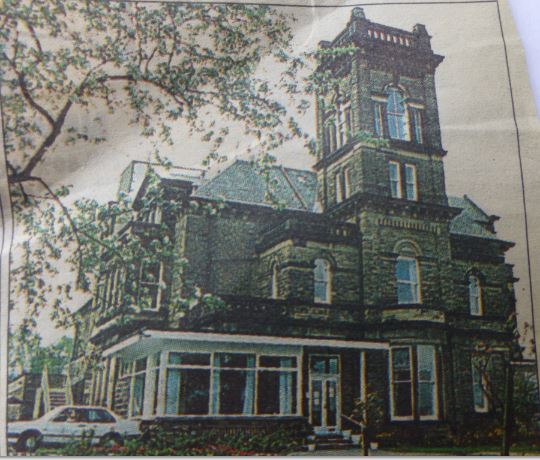
6. Turn right up the drive to Craiglands, walk along path to reach Cowpasture Rd. Craiglands Hydro BP 14 - the only surviving hydro hotel. It has a new spa.
7. Back on Cowpasture Road, turn right and then immediately turn right and walk up the path to and through the gate at the top. Either walk up the steps to the rough path or right up sloping path which ends with some steps up to the Tarn.
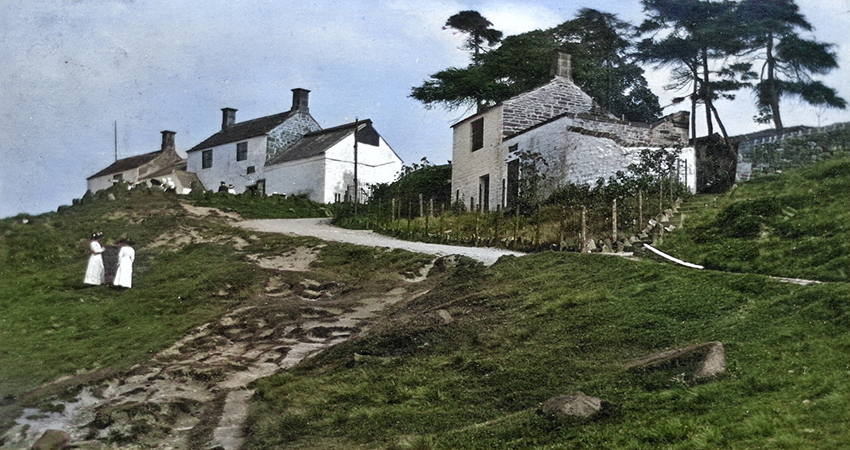
8. The White Wells bathhouse is further up the moor. There are a number of paths that lead to White Wells. White Wells new baths were built in the 1790s by Squire Middelton. There is a drinking fountain behind.. Flags fly when the small café (cash only) and bath-house museum are open. The smaller 1829 Charity Bath-house is just beyond White Wells.
9. After enjoying the splendid views over the town and, to the left, up Wharfedale, walk down the gravel path which crosses a stream and then descends to Wells Road.
10. Turn right to walk down to Broderick Drive on the left and walk along to the large stone. Wells House BP 3 is now apartments and the grounds are private
11. Contiue to walk down to Darwin Gardens Millennium Green. The car park is the site of West View Bandstand, constructed in 1904, removed in 1950s
12. Walk down Wells Rd. There is a pair of houses by the entrance to Wells House stables then a pair of large1870s semis. Look at the hollow by the first semi, a former mill pond Cross Queens Road. The upper corn mill stood here.
13, Enter Mill Ghyll and walk down the path. In the middle of this Ghyll was the lower corn mill which was demolished in 1873. The stone fomr the mill was used to edge the paths. William Middelton leased this narrow strip of land to the Local Board in 1873 at a rent of one shilling per annum, At the bottom of the Ghyll, the brook goes into a culvert. Just before the main road is a large water fountain. This has replaced the original fountain built in 1875 by public subscription for £135. The new gravity-fed fountain’s design was created to reflect the sphagnum moss which is found in abundance on Ilkley Moor. It was opened in 2025 by Alan Titchmarsh.