Ilkley Artisan Town Walk
A Self-guided Walk: Ilkley’s Artisan Town
A walk below the railway track including the railway town conservation area. A condition of the 1867 land sales, land below the railway could be used for business so smaller terraced houses, lodging houses, workshops, smithies and builders’ yards were built.
1. Start at Ilkley Manor House, Castle Yard, Church Street (*blue plaque). Walk onto Church Street through the arch, turn left, then onto the path beside All Saints churchyard towards New Brook Street. All Saints, Anglo-Saxon church mentioned in the Domesday Book, it has a 15th century tower and 19th century south extension.
2. Go down the steps, turn left, walk down then cross New Brook Street to walk along Castle Road. Pass the late 20th century Castle Gate apartments to Ilkley Playhouse (*blue plaque)
3. Turn right and walk up Weston Road to the Pinfold (*blue plaque). When this street was built in 1870s the old Smithy was demolished and some Roman remains were found, possibly from baths.
4. Walk back towards the Playhouse then cross the road and turn right to walk along Wharfe View Road, passing Margaret Court on your left, built as a convalescent home in 1870s, later it was an orphanage for girls from the Otley Workhouse.
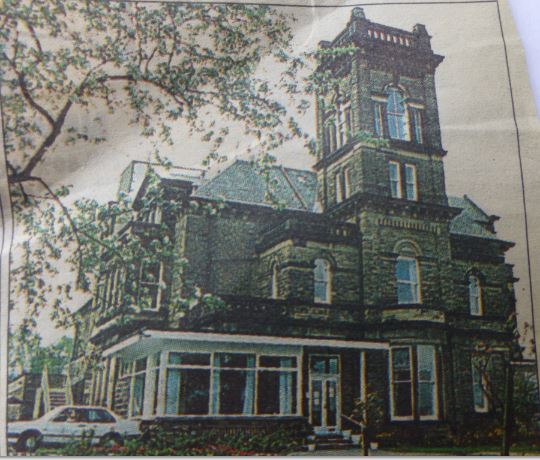
5. Continue down Wharfe View Road. At the end of the road on your right is Tower Court (*blue plaque) - the former 1872 National School, All Saints Junior School. The house with the tower was originally lived in by the headmaster.
6. Continue to end of Wharfe View Road to Leeds Road. On the left the car park was the site of the 1876 Primitive Methodist Chapel. When this closed in 1969 the congregation joined Wells Road Methodist Church.
7. At A65 Leeds Road. Look across the road – The Operatic House was built in 1899 as The Parish Institute - a hall and Sunday School for All Saints Church. To its right Walton’s and Ilkley Cinema were built for the Leeds Industrial Co-op Society in 1899. To the left is Booth’s Supermarket built on the site of the 1872 new Gas Works bought by Ilkley Urban District Council in 1893.
8. Turn left and walk to the traffic lights, cross Leeds Road and cross Lower Wellington Road, then continue along Leeds Road pavement. Booths stone wall was built by the Gasworks Company. Over the A65 is All Saints Court built on the site of 1894 All Saints Infant School. Also across the A65, after Bath Street, the stone-built Ash Terrace is part of an 1875 building club of 81 houses built by the architect George Smith. [Inspired by Saltaire].
9. continue along Leeds Road. The Drill Hall (*blue plaque) is on your right. This stone building was the base for the Saturday voluntary soldiers and first aid classes. The Drill Hall Yard at the back is now a light industrial estate.
10. Continue down Leeds Road to the pelican crossing. Turn right to walk up Dean Street. On the corner the modern housing block is on the site of the 1901 Leeds Road Congregational Hall which closed in 1970. Dean Street is one of many terraced streets built between 1867 and 1912 by the Dean Brothers, a second generation of Ilkley builders. Across the top of the road is a hedge behind which is a former farmhouse.
11. Turn right on to East Parade. Here are Edwardian terraces. At its far end is the industrial estate including Drill Hall yard.
12. Turn left to walk up North Parade. A row of terraces is on the west/right side with a long-established fish shop at the top. On the left was a field where houses were developed through the 1900s. At the top of the field a PSA Hall was set up in 1902. The PSA - Pleasant Sunday Afternoon - movement was a non-conformist temperance evangelical outreach to working people, with many self-improvement classes and sports. In 1936 the Salvation Army took it over.
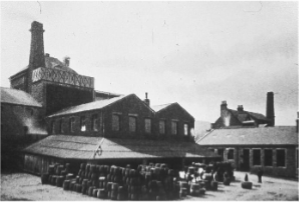
13. At top of North Parade cross Little Lane and walk up Brewery Road to the top . The houses on the left were built in the 1890s. The terrace houses on the right, with stone arches over each door, were built in the 1870s for the Brewery Company. To take advantage of the water supply available here, the Ilkley Brewery and Aerated Water Company started in 1873 and these houses were built by Bradford architect Samuel Jackson. The brewery closed in the 1920s and became a base for local companies. During WW2 Daltons cereal flakes were made here. By the1950s it was Spooners Industries. This century, the brewery was demolished for a Tesco supermarket which didn’t proceed. The site is now the Scholars Court apartments.
14. Turn right and walk down Railway Road crossing Mornington Road, Wilmot Road and Golden Butts Road. Across the road was the Alpha Mill which was a steam corn mill built in 1873.The base of the chimney can still be seen. Looking down Golden Butts Road: the building with the tower on the right was the 1894 fire station with 4 cottages opposite for firemen as IUDC developed the street for council services on the former end/butts of agricultural fields – hence “Golden Butts.”
15. Continue along Railway Road, cross Wellington Road and Nelson Road, then turn right to walk down Nelson Road. The Dean Brothers built the left-hand terrace in 1876 to live in two of them. This included Victoria Baths and Hall and the laundry at the bottom because there was a water supply here. On the right by the archway was the home and builder’s yard for Eagle & Mawson who built the terrace there in the 1880s.
16. Turn left ontoTrafalgar Road and follow the road until it joins Railway Road again. This street, and also Victory and Nile Streets, were built in the early 20th century mainly by Ilkley builders and joiner Deans & Mennell on the former Ilkley Cricket Field behind Nelson Road.
17. Turn right to walk along Railway Road to Brook Street. The large wall on the left was built for the 1888 railway extension taking trains to Skipton over Brook Street on an iron bridge until 1965. Look to see a filled in archway which was the entrance for a subway to Platform 4.. On the right corner the gabled semi-detached shops were built in 1908 by Ilkley builders and joiners Deans & Mennell where they had their building company office. Boyes [formerly Hillards Supermarket in the 1970s then Coop Sunwin House] was the site of the 1927 New Cinema, later an Essoldo cinema and ballroom. On the left at the delivery yard for Marks and Spencer look up to see where the railway ran. On the right is a tall archway built in the1890s for Beanlands Grocery store entrance to their back warehouse.
17. At Brook Street turn right. Brook Street is now a wide road because in 1854 the stream that ran down from the moor was culverted. The shops on the right were built after the 1867 Ilkley land sales as houses, before being converted to shops. At the bottom right is The Crescent Hotel *blue plaque. On the opposite side of Brook Street, Boots was Shuttleworth’s 1870 Gothic House gift emporium where the Ilkley Gazette was published - look up at the pointed gables. Next is the 1855 Brook Terrace, the first purpose-built shops in Ilkley village built by Elizabeth Beanlands.
18. Cross Brook Street at the traffic lights and walk down Church Street (A65). On your right across the road is the graveyard wall of All Saints Church and on your left is The Black Hat, originally The Rose & Crown, a coaching inn rebuilt in the 1890s by The Ilkley Brewery.
19. At the pedestrian crossing cross Church Street and turn left to go through the archway to bring you back to Castle Yard and the Manor House.
Ilkley Civic Society Dec 2020